
High-Precision Tracking for Demanding Applications
From the warehouse floor to the construction site, Enpose provides sub-millimeter 6-DoF positioning where traditional systems fail.
Application Highlight: Robot Calibration & Monitoring
In modern manufacturing, industrial robots are renowned for their repeatability – their ability to return to the same programmed position within a fraction of a millimeter. However, their absolute accuracy often falls short. Factors such as gear backlash, manufacturing tolerances, and structural joint compliance can lead to errors of several millimeters when a robot is commanded to move to a specific coordinate in 3D space.
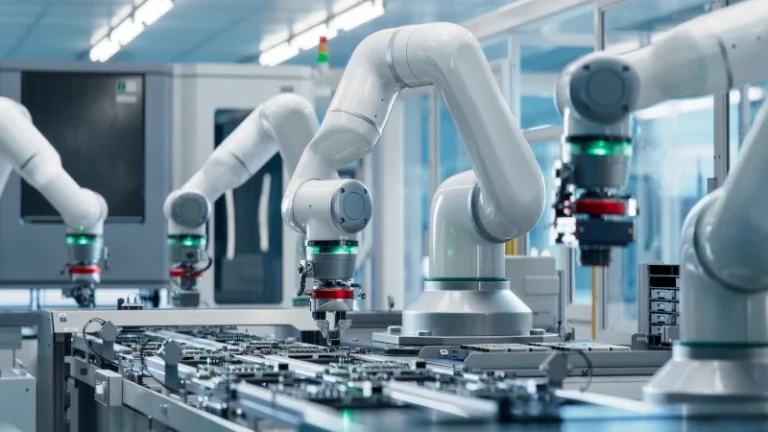
Our 6-DoF tracking solution bridges this gap by providing a high-precision external reference frame. By mounting an active infrared marker to the robot’s tool flange, our system measures the absolute pose of the end-effector in real-time, enabling a level of precision that the robot’s internal encoders cannot achieve on their own.
Traditional kinematic calibration is often a one-time process performed in a controlled environment. In reality, industrial settings are dynamic. One of the most significant challenges is thermal drift: as motors heat up during operation, the robot’s links expand, causing the tool center point to shift.
By integrating our sensors into the production cell, you can:
- Compensate for Thermal Expansion: Continuously monitor and correct for positional drift caused by temperature changes.
- Eliminate Manual Recalibration: Reduce downtime by automating the mastering process, ensuring the robot stays accurate across shifts without manual intervention.
- Enable High-Precision Tasks: Confidently deploy standard industrial robots for demanding applications like aerospace drilling, friction stir welding, or large-scale additive manufacturing.
For applications where the workpiece position may vary, our system supports visual servoing and path correction. Instead of relying on a static program, the robot can adjust its trajectory based on the live 3D feedback from the marker. This ensures that accuracy is maintained even if the environment changes or the robot’s mechanical state evolves over time, resulting in higher yields and significantly less scrap.
Application Highlight: AGV Navigation
In today’s automated world, fleets of Automated Guided Vehicles (AGVs) are commonly deployed in warehouses to autonomously transport goods to and from their storage location. In such a setting, each AGV of the fleet follows a specific trajectory that is chosen by a central command system. For following its course, an AGV must precisely know its current position. If the position estimate is just slightly off, then this can lead to collisions with obstacles such as shelves in a densely packed warehouse.
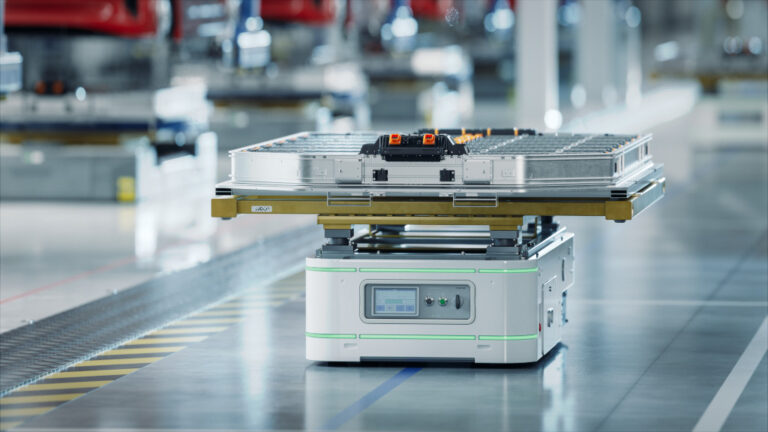
Traditionally, AGVs are equipped with numerous sensors such as LIDARs, time-of-flight (TOF) or structured light camera systems, in order to facilitate the AGVs to determine their location. Distance measurements from these sensors are then compared to an occupancy map of the warehouse. This map needs to be continuously updated for the AGVs to maintain the capability to localize themselves with high accuracy.
Equipping an entire fleet of AGVs with a multitude of advanced sensor systems can be a costly endeavor. This predicament was one key motivation for the design of our 6-DoF tracking solution: Instead of equipping each AGV with their own suite of sensors, it is sufficient to outfit them with one of our active infrared markers. These markers are small, inexpensive, consume relatively little power, and can be easily customized.
Our intelligent camera sensors are then deployed throughout the warehouse. The sensors recognize the code that is broadcast by each marker, which allows each AGV to be uniquely identified. If a marker is detected by at least two sensors, its full 6-DoF pose can be calculated with high accuracy.
Thus, instead of mounting a sensor on each AGV, the sensors are mounted in the facility. A single sensor can simultaneously detect and locate a large number of AGVs. This reduces the total number of required sensors, which significantly reduces cost.
The use of our 6-DoF tracking solution also greatly simplifies the system design. The sensor network reliably locates and tracks the 3D position of each marker. No processing of low-level sensor data or cumbersome environment mapping is needed by the user. This streamlines and accelerates the development of new automation solutions.
Application Highlight: Real-Time Tracking for Construction Machinery
On dynamic construction sites and in busy industrial yards, knowing the real-time position of heavy machinery such as excavators, cranes, and forklifts is critical for both operational efficiency and worker safety. These environments are constantly changing, often exposed to the elements, and filled with moving equipment — making accurate, robust tracking a technological challenge.
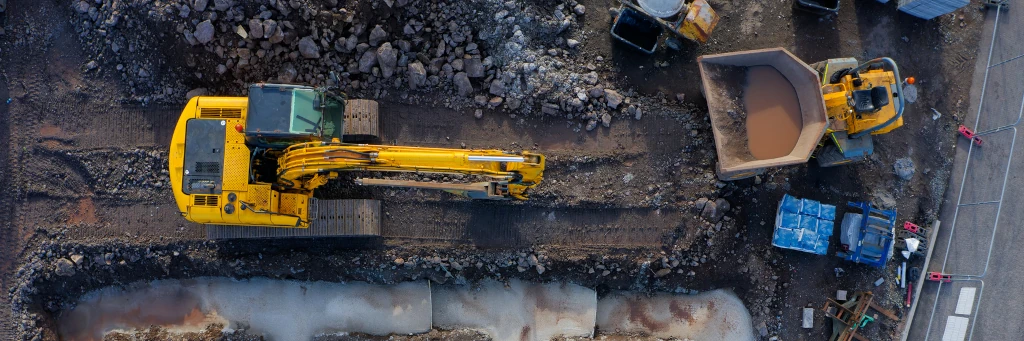
Our optical 3D tracking solution provides a reliable alternative to traditional GNSS or radio-based positioning systems, which often struggle with signal blockage, multipath interference, or insufficient accuracy in dense environments.
By equipping each construction machine with a rugged, waterproof active infrared marker, and deploying our intelligent camera sensors around the site, you can achieve precise, real-time 3D tracking with millimeter-level accuracy—even in direct sunlight or dust-prone outdoor settings.
Key advantages for construction and logistics applications include:
- Collision avoidance in confined spaces and loading zones
- Real-time location tracking for machine coordination and task planning
- Geofencing and safety zone enforcement
- Automated activity logging for operations and maintenance analysis
- Simplified system architecture — no complex onboard sensors or environment mapping required
Because each marker has a unique code, machines can be individually tracked and identified, enabling centralized monitoring of large fleets across expansive or cluttered areas. Sensors installed on buildings, poles, or mobile rigs observe the markers, with detection handled locally to reduce latency and network load.
Our system minimizes on-machine hardware, reducing cost, power consumption, and maintenance. It also scales easily — adding new vehicles or reconfiguring a site layout only requires minimal setup.
In short: Whether you’re coordinating a construction fleet or managing high-throughput industrial operations, our optical tracking system increases safety, boosts productivity, and simplifies system integration.
Customization Possible!
If our off-the-shelf systems don’t meet your needs, don’t worry! We can customize both hardware and software to suit your specific requirements, as part of our Design Services. Simply let us know what you’re looking for, and we’ll deliver a tailored solution.
What We Can Customize
Here are some examples of how we can adapt our technology to meet your specific needs:
Custom Marker Electronics
We can develop fully customized marker hardware, including power, communication, and form factor adaptations—or integrate our technology into your existing electronic systems.
Optics and Image Sensors
Select from a range of optical components and image sensors to optimize field of view, resolution, or spectral sensitivity for your environment.
Hardware and Software Interfaces
Whether you need to support specific communication protocols or electrical interface standards, we can help. From low-level hardware integration to custom APIs, we ensure smooth connectivity with your existing systems.
Mechanical Design
From compact enclosures to ruggedized outdoor systems, we offer custom mechanical solutions that meet the spatial, environmental, or aesthetic needs of your setup.